Pages

Saturday, 6 October 2012

Apple's iPhone 5 gets thumbs-up from Consumer Reports

SAN FRANCISCO: Consumer Reports, the influential reviewers' group that blasted the iPhone 4 for a faulty antenna, has given Apple Inc's latest smartphone a thumbs-up despite echoing widespread complaints about its patchy mapping service. 

The organization, which in 2010 withheld its recommendation for the iPhone because of spotty reception when the gadget was held in a certain way, said laboratory tests confirmed that the new iPhone 5 ranked among the best smartphones but its mapping function clearly fell short.
Apple's latest iPhone, sporting a larger 4-inch screen and 4G capability, drew scathing reviews for glaring errors in a new, self-designed mapping service. Chief Executive Tim Cook apologized last week and directed users to rival services run by Google Inc and others.
"Despite the widespread criticism it has received, Apple's new Maps app... is competent enough, even if it falls short of what's available for free on many other phones," reviewer Mike Gikas wrote on the group's website on Friday.
"As Apple has recently apologized and promised to fix these and other map glitches, we expect the Map app to improve in time," he wrote.
Apple's shares were down 1.3 percent at $658.43 in early afternoon trade on Nasdaq.
The consumer electronics juggernaut began selling its latest smartphone last month. Sales of over 5 million in its first three days in stores fell short of outsized expectations as it struggled with supply constraints.
Its homegrown Maps -- stitched together by acquiring companies and employing data from a range of providers including TomTom NV and Waze -- was introduced with much fanfare in June by software chief Scott Forstall. It was billed as a highlight of the updated iOS 6 software.
Errors and omissions quickly emerged after the software was rolled out. They ranged from misplaced buildings and mislabeled cities to duplicate geographical features. Users also complained that the service lacked features that made Google Maps so popular, such as public transit directions and street-view pictures.
The last time Apple faced such widespread criticism -- including from Consumer Reports -- was during 2010's "Antennagate" furor, when users complained of signal reception issues on the then-new iPhone 4. This year the consumer group, which reviews everything from cars to kitchen appliances, also warned initially that Apple's new iPad threw off too much heat.

A defiant Steve Jobs at the time rejected any suggestion the iPhone 4's design was flawed, but offered consumers free phone cases at a rare, 90-minute press conference called to address those complaints.
"Now that our auto experts have completed their tests, including some carried out some days after the launch, they describe the app as relatively streamlined, and concluded that it generally provides clear guidance, including voice and on-screen directions," Gikas wrote.
"However, they did find that it lacks the details, traffic data, and customization options offered by the free Google navigation app found on Android phones."

pre-program pc shutdown time

Have you ever been in a situation where you had to leave your personal computer on and go for a dinner.
Or perhaps you wanted to sleep while along-drawn software update/download was running on your PC?
You want to shut down and move but you can't.
Help is at Hand!
you can actually shutdown your according to your preplanned schedule automatically...


here are the steps..
1> Download chameleon shutdown from here

2>Once you have installed this u will get several options like shut down, hibernate, sleep etc

3>Now make scheduleof your own wish and enjoy!!

Wednesday, 3 October 2012

run android on pc

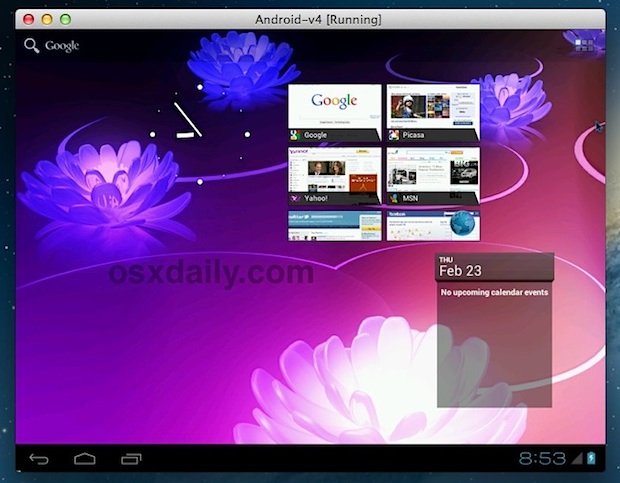
Run Android 4 ICS (Ice Cream Sandwich) on a Mac or PC with VirtualBox


Android 4 ICS VirtualBox
If you want to play around with Android 4 Ice Cream Sandwich (ICS) but don’t have an Android phone or tablet, you can download the official Android SDK, or better yet, grab a preconfigured virtual machine that will run ICS in VirtualBox. Other than providing an interesting look at the primary competitor to iOS, virtual machines are useful for compatibility testing, and developers and designers should find some value in adding an Android VM alongside their Windows & Internet Explorer VM’s, giving this some practical use beyond the novelty factor.
Here’s how to run Android 4 ICS in VirtualBox:
  • Download VirtualBox and install it (free)
  • Grab a preconfigured ICS set up from VMLite (free)
  • Uncompress the Android -v4.7z file, look for “Android-v4.vbox” and double-click it to load and boot the configuration into VirtualBox
  • At the boot menu in VirtualBox, select the lower “Android Startup from /dev/sda” option
  • Let Android ICS boot
That’s really all there is to it. The VMLite configuration is complete with mouse support and you’ll find the blue cursor as a replacement for a touch screen. You can switch to full screen mode by pulling down “View” and selecting “Switch to Fullscreen”, just remember to hit Command+F is how to exit out of that. Hitting Command+C will run the VM in scale mode, which is what the screenshots are showing.
I ran this in Mac OS X 10.7, but VirtualBox is offered for Windows and Linux as well so it should work just about anywhere you try it. You can alternatively grab a variety of different versions from Android x86, I was able to use the android-x86-4.0-eeepc-20120101.iso successfully as well and it has the added benefit of some gesture support, although the boot iso’s require a bit more configuration within VirtualBox to get going. As mentioned before, the Android SDK is also free to download and includes an emulator, but the VM setups are much easier to get working quickly.

You can drag widgets and app icons onto the home screen, some are interactive and overall the homescreen/desktop is very customizable as a result.

The Android web browser works fine too, this is potentially the most useful feature for web developers and designers since it allows to quickly check compatibility of sites and web apps.
If for some reason you want to run older versions of Android instead you can do that too, and don’t miss our other posts on virtual machines.

Samsung Galaxy Note II

The Samsung Galaxy Note II is a smartphone–tablet computer hybrid designed, developed and marketed by Samsung. It is the successor to the Samsung Galaxy Note, and is the third device of the company's Note series, which places emphasis on the use of a stylus. Employing a 1.6 GHz quad-core processor, the device sports a 5.55-inch (141 mm) diagonal display with 720p resolution, 2 GB of RAM, and a maximum of 64 GB storage. IT is the first Samsung phone to come with Android version 4.1 "Jelly Bean" as standard
The Galaxy Note II was unveiled 29 August 2012 at the Berlin Radio Show.
Given the larger than average screen on this smartphone, it has been referred to in some circles as a smartphone - tablet computer hybrid known colequially as a "phablet". Samsung however officially markets this device as a Smartphone.

Tuesday, 2 October 2012

DARK ENERGY-REALITY


Dark Energy Is Real, Say Astronomers


Dark energy, a mysterious substance thought to be speeding up the expansion of the Universe is really there, according to a team of astronomers at the University of Portsmouth and LMU University Munich.
After a two-year study led by Tommaso Giannantonio and Robert Crittenden, scientists conclude that the likelihood of its existence stands at 99.996 per cent. Their findings are published in the Monthly Notices of the Royal Astronomical Society.
Professor Bob Nichol, a member of the Portsmouth team, said: "Dark energy is one of the great scientific mysteries of our time, so it isn't surprising that so many researchers question its existence.
"But with our new work we're more confident than ever that this exotic component of the Universe is real -- even if we still have no idea what it consists of."
Over a decade ago, astronomers observing the brightness of distant supernovae realised that the expansion of the Universe appeared to be accelerating. The acceleration is attributed to the repulsive force associated with dark energy now thought to make up 73 per cent of the content of the cosmos. The researchers who made this discovery received the Nobel Prize for Physics in 2011, but the existence of dark energy remains a topic of hot debate.
Many other techniques have been used to confirm the reality of dark energy but they are either indirect probes of the accelerating Universe or susceptible to their own uncertainties. Clear evidence for dark energy comes from the Integrated Sachs Wolfe effect named after Rainer Sachs and Arthur Wolfe.
The Cosmic Microwave Background, the radiation of the residual heat of the Big Bang, is seen all over the sky. In 1967 Sachs and Wolfe proposed that light from this radiation would become slightly bluer as it passed through the gravitational fields of lumps of matter, an effect known as gravitational redshift.
In 1996, Robert Crittenden and Neil Turok, now at the Perimeter Institute in Canada, took this idea to the next level, suggesting that astronomers could look for these small changes in the energy of the light, or photons, by comparing the temperature of the radiation with maps of galaxies in the local Universe.
In the absence of dark energy, or a large curvature in the Universe, there would be no correspondence between these two maps (the distant cosmic microwave background and relatively closer distribution of galaxies), but the existence of dark energy would lead to the strange, counter-intuitive effect where the cosmic microwave background photons would gain energy as they travelled through large lumps of mass.
The Integrated Sachs Wolfe effect was first detected in 2003 and was immediately seen as corroborative evidence for dark energy, featuring in the 'Discovery of the year' in Science magazine. But the signal is weak as the expected correlation between maps is small and so some scientists suggested it was caused by other sources such as the dust in our galaxy. Since the first Integrated Sachs Wolfe papers, several astronomers have questioned the original detections of the effect and thus called some of the strongest evidence yet for dark energy into question.

In the new paper, the product of nearly two years of work, the team have re-examined all the arguments against the Integrated Sachs Wolfe detection as well as improving the maps used in the original work. In their painstaking analysis, they conclude that there is a 99.996 per cent chance that dark energy is responsible for the hotter parts of the cosmic microwave background maps (or the same level of significance as the recent discovery of the Higgs boson).
"This work also tells us about possible modifications to Einstein's theory of General Relativity," notes Tommaso Giannantonio, lead author of the present study.
"The next generation of cosmic microwave background and galaxy surveys should provide the definitive measurement, either confirming general relativity, including dark energy, or even more intriguingly, demanding a completely new understanding of how gravity works."